
As the world heads to Belém, Brazil, for the 30th UN Climate Change Conference (COP30), happening next week from the 10th to the 21st of November 2025, the sense of history is unmistakable. It will be a full decade since the Paris Agreement promised a pathway to limit global warming to 1.5°C, and yet emissions continue to rise, finance remains elusive, and inequality deepens. For many, this is not simply another negotiation; it is the moment to decide whether global climate cooperation still works.
Belém, in the heart of the Amazon, offers both symbolism and substance. It is the world’s largest carbon sink and one of its most contested frontiers, a living reminder that climate justice is not only about gigatonnes of carbon, but also about people, land, and power. The question is whether COP30 can turn that symbolism into systemic change.
Several converging forces make COP30 uniquely consequential. It is the first major COP of the Paris Agreement’s second decade, where countries are expected to bring forward new and more ambitious climate commitments - Nationally Determined Contributions (NDCs) - that stretch to 2035. It comes immediately after the global stocktake confirmed what many feared: the world is far off course, with current policies pointing toward nearly 2.7°C of warming.
Beyond that, the summit will test whether climate action can be rooted in justice. The global South, from the Amazon to Africa to the Pacific, is demanding not just higher targets, but fairer ones: targets backed by finance, technology, and genuine inclusion. After years of promises, patience is wearing thin.
Negotiation Strands That Will Shape the Outcome:
At the heart of COP30 lie six intertwined negotiation arenas, each one a make-or-break determinant of whether this process still carries meaning.
Ambition and NDCs: The world’s first test in Belém is ambition. Every country is expected to table a stronger 2035 target that reflects both science and responsibility. Yet so far, only a handful have submitted theirs. The Global Stocktake exposed that national pledges still fall drastically short of what is required to hold warming to 1.5°C. This means that COP30 must close the “ambition gap” not through rhetoric, but through credible implementation pathways. The key question is whether the major emitters (China, the United States, India, the EU, and others) will set the pace or stall the process.
Mitigation and Fossil-Fuel Phase-Out: The debate around fossil fuels will be fierce. For the first time, pressure is mounting for a clear political signal, not just a vague commitment to “phase down unabated fossil fuels,” but a defined trajectory for ending coal, oil, and gas dependence. Brazil’s dual identity as both a petro-economy and the steward of the Amazon puts it at the crossroads: can it lead a credible global narrative that reconciles energy transition with forest protection? The world will be watching whether Belém can finally deliver the long-awaited language on a fossil-fuel phase-out, backed by renewable energy scaling and just transition finance for developing regions.
Adaptation and Loss & Damage: For vulnerable nations, adaptation is not charity; it is survival. The impacts of floods, droughts, and cyclones are already erasing decades of development. After years of negotiation, the Loss and Damage Fund was established, but remains underfunded and bureaucratic. COP30 must move beyond declarations and design operational systems that are accessible, predictable, and responsive to communities on the frontlines. The demand from Africa, Latin America, and Small Island States is simple: don’t just acknowledge loss, finance recovery.
Climate Finance and Investment: Perhaps the most critical and politically fraught strand is climate finance. COP29 in Baku produced a new collective quantified goal (NCQG) of $1.3 trillion per year by 2035, but without a roadmap, it remains a headline without a heartbeat. COP30 must define the who, the how, and the when: who contributes, through which instruments, and how these funds reach developing countries without deepening debt. Beyond public finance, this discussion implicates multilateral development banks (MDBs), from the World Bank to the AfDB, whose reform and recapitalisation have become central to unlocking affordable finance for the transition.
Nature, Forests, and Biodiversity: The Amazon setting transforms the “nature” agenda from a side issue into the centrepiece. Protecting forests, biodiversity, and Indigenous territories is now inseparable from climate mitigation and adaptation. Brazil, as host, has a chance to pioneer a new global compact that ties deforestation-free supply chains, Indigenous rights, and restoration finance into the main COP outcome. Civil society groups are pushing for a dedicated “forest and communities facility” that channels funds directly to those safeguarding ecosystems, not through top-down intermediaries but through community-based stewardship.
Governance, Transparency, and Accountability: Finally, even the best pledges mean little without systems to track and enforce them. Strengthening transparency frameworks, including robust reporting on both emissions and finance flows, is essential to rebuilding trust. This is especially true for developing countries that have repeatedly seen promises evaporate after the cameras leave. Belém must therefore deliver stronger rules on accountability and data verification, not as bureaucratic exercises but as moral imperatives.
Together, these six strands will determine whether COP30 is remembered as a turning point or another diplomatic photo-op.
For Africa, Latin America, and the wider Global South, COP30 is about justice, sovereignty, and survival. A credible finance package could unlock renewable energy, adaptation projects, and local resilience. And the reform of MDBs could finally channel capital to community-level transitions rather than large-scale extractive projects. If equity principles are respected, COP30 could strengthen the hand of civil society movements pushing for locally owned energy systems, gender justice, and intergenerational fairness. But if the summit fails, the pressure will fall back on national and regional initiatives such as the African Development Bank’s Climate Action Window, community energy programmes, and municipal-level transitions. The message will be clear: transformation must continue, even if the global process falters.
Envisaged Outcomes: What Success Could Look Like
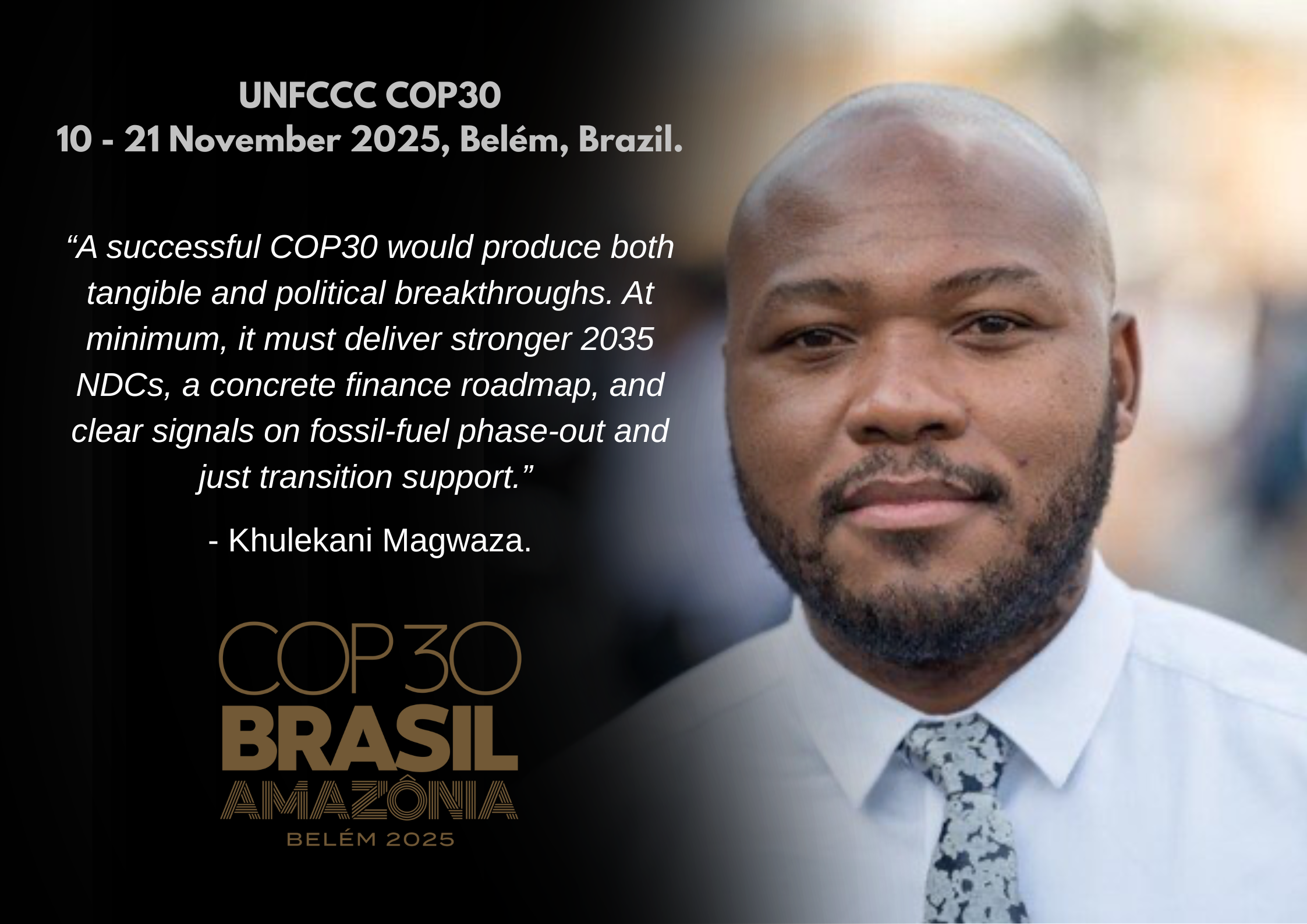
A successful COP30 would produce both tangible and political breakthroughs. At minimum, it must deliver stronger 2035 NDCs, a concrete finance roadmap, and clear signals on fossil-fuel phase-out and just transition support. Ideally, it would also launch a bold mechanism for forest protection, operationalise the Loss and Damage Fund with real money, and set accountability systems that finally close the credibility gap.
On the aspirational front, the world hopes to see timelines for phasing down fossil fuels embedded in the COP text, an Amazon Declaration linking forests and finance, and perhaps even a “Just Transition Compact” that secures resources for workers and communities in coal, oil, and gas regions. Achieving this, however, will require unprecedented political will, and a willingness by developed nations to move from moral posturing to material delivery.
The Decade of Delivery: COP30 will test whether the world can move from promises to performance. In Belém, surrounded by the world’s lungs, leaders have the chance to breathe new life into the Paris Agreement, or watch it suffocate under the weight of unmet commitments. This is more than a diplomatic milestone. It is a moral reckoning, between the rhetoric of ambition and the reality of action; between a future powered by justice and one poisoned by inertia. Whether the Amazon becomes the cradle of a renewed global covenant or a monument to broken promises will depend on what happens in those two weeks in November 2025.