
In the heart of Pietermaritzburg (capital city KwaZulu Natal), communities like Jika Joe and Masukwana live at the sharp end of South Africa’s uneven development story. Streets pile up with uncollected waste, toilets are scarce or broken, and safety remains fragile. Yet these same residents buy bread, paraffin, data, airtime, and transport every day, each purchase carrying 15% VAT into the national fiscus. They are, in every sense, taxpayers, even if they don’t appear on municipal valuation rolls or pay property rates.
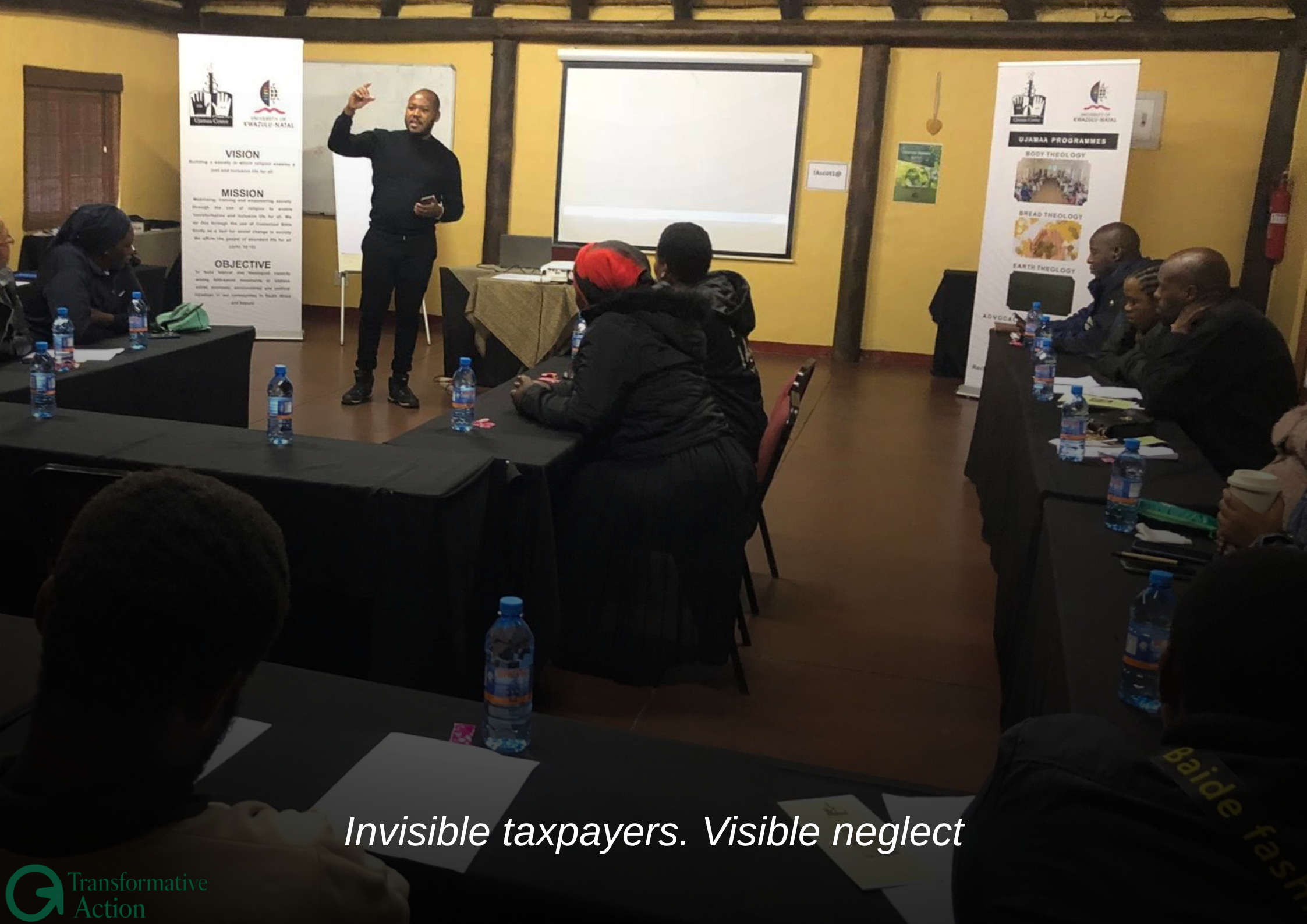
This reality exposes a deep contradiction in South Africa’s local governance system: the people who contribute daily through consumption taxes are too often the ones left out of service delivery and urban investment. While Msunduzi Municipality faces legitimate fiscal constraints, the question is not whether there is money, it’s how that money flows, and who benefits from it. This reflection, inspired by discussions from a recent UKZN Ujamaa Centre workshop on Contextual Bible Study using the See-Judge-Act approach, takes a closer look at the resource flows, rights, and accountability gaps shaping life in Jika Joe/Masukwana. Drawing from the lived experiences and voices of community members who spoke about waste, sanitation, and safety challenges, it asks what a more equitable public finance system might look like, one that recognises the economic participation of informal residents and ensures that basic services are not a privilege reserved for ratepayers, but a right owed to all city dwellers.
When communities like Jika Joe and Masukwana raise concerns about overflowing waste, absent toilets, and rising insecurity, the question is not just “why is the government failing them?” but also “what resources exist, and how are they allocated?” This version of reflection leans into numbers, accountability, and the logic of public finance.
Who pays, and who benefits, or doesn’t benefit?
In South Africa, Value-Added Tax (VAT) quietly links even the most marginalised communities to the national economy. Every loaf of bread, litre of paraffin, or data bundle bought in places like Jika Joe/Masukwana carries a 15% VAT charge, collected by vendors and submitted to the South African Revenue Service (SARS). In that sense, residents of informal settlements are not “outside” the financial system, they are active participants in it, contributing to the public purse each time they make a purchase.
Municipalities themselves also operate within this VAT framework. When their taxable supplies, such as service charges for water, electricity, refuse, or sanitation, exceed R1million per year, they are required to register as VAT vendors (Municipal Finance Management Act). And we understand that some municipal transactions, such as property rates, may be zero-rated for VAT, but even those who do not pay formal property rates still pay indirect taxes every day through consumption.
This challenges the common assumption that only ratepayers “fund” municipal services. In reality, low-income households are invisible taxpayers, sustaining the fiscal system through their spending while often receiving the least in return. If South Africa’s public finances are built on general taxes, including VAT, then the benefits should flow more equitably, not only to those on the valuation roll but also to those whose contributions are hidden in every till slip.
Let’s look at the Msunduzi municipality’s 2025/26 budget (link):
Msunduzi projects an operating revenue of +- R9.5 billion for 2025/26, a 6,53% increase from 2024/25.
However, the municipality is under financial strain: low cash coverage (i.e. limited cash reserves).
The budget indicates that rising charges from Umgeni Water and Eskom have pushed up the cost of bulk water and electricity, forcing the municipality to increase service tariffs for residents. However, these repeated tariff hikes are not sustainable, eventually, they will reach a point where essential services become unaffordable for many households, which is already a lived reality for informal settlements such as the Jika Joe.
These figures or issues show that Msunduzi is not completely broke, but it lives with tight margins, risk, and systemic inefficiencies. Despite the city’s financial constraints, something can be done. The challenge is not always a lack of money, but how existing resources are prioritised and protected. Even with tight municipal finances, change is possible. What’s often missing is not the money itself, but how it’s directed and protected. Within Msunduzi’s current operating budget of about R9.5 billion, even a 0.2% reallocation, a fraction of a percent, could fund tangible improvements in community services. That amounts to roughly R19 million, enough to begin restoring dignity and safety in areas like Jika Joe.
Example budget reallocation / targeted investment (within current constraints):
If Msunduzi ring-fenced just 0.2% of its annual operating revenue for basic service interventions, here’s what that could achieve in a single financial year:
What I think prevents this reallocation:
Conditional grants and earmarked funds: Much capital and operating funding comes tied to national or provincial grants with strings attached (you must use it for X purpose).
Revenue collection failure: If the municipality can’t collect user charges or debts, the cash shortfall forces cuts or deferral of maintenance and other projects (which is often very problematic for poor communities, because, for instance, a delayed repair today becomes a major breakdown tomorrow. Poor communities end up living with chronic failures, blocked drains, leaking taps, overflowing waste, etc, because the municipality keeps “deferring” maintenance. This creates a cycle of visible decay, where informal settlements become further marginalised and less likely to be prioritised in future budgets.
Poor planning & accountability mechanisms: If ward committees or community voices are weakly included in budget priority setting, the margin for pro-poor allocations shrinks.
If communities like Jika Joe can contribute daily through VAT, they deserve to see those contributions reflected in clean streets, working toilets, and safer spaces. Public finance is not just about balance sheets, it’s about who counts and who benefits. Even small reallocations, smarter spending, and better accountability can turn budgets into tools for justice. That is people’s rights.