
When we talk about climate finance, we often imagine new pledges, climate funds, and international aid. But the real story is hidden in three technical-sounding words now dominating global discussions: MDB reform, balance sheet optimisation, and capital adequacy. They may sound like banker jargon, but they hold the keys to unlocking hundreds of billions of dollars for renewable energy, adaptation, and just transitions across the Global South.
Multilateral Development Banks, like the World Bank, African Development Bank, and Asian Development Bank, were built decades ago to fund traditional development projects. Today, we face multiple crises: climate change, debt, inequality, and energy poverty. Yet MDBs still operate as if it’s the 1950s. Reforming them means updating their mission, governance, and finance models so they can truly support the just energy transition.
Our reform calls are about:
Expanding their mandate beyond economic growth to include climate justice and resilience.
Phasing out fossil fuel finance and ending support for false solutions like mega-hydro or carbon capture.
Ensuring developing countries and civil society have a greater voice in decisions.
In essence, MDB reform is about re-wiring the system to serve people and the planet — not just markets.
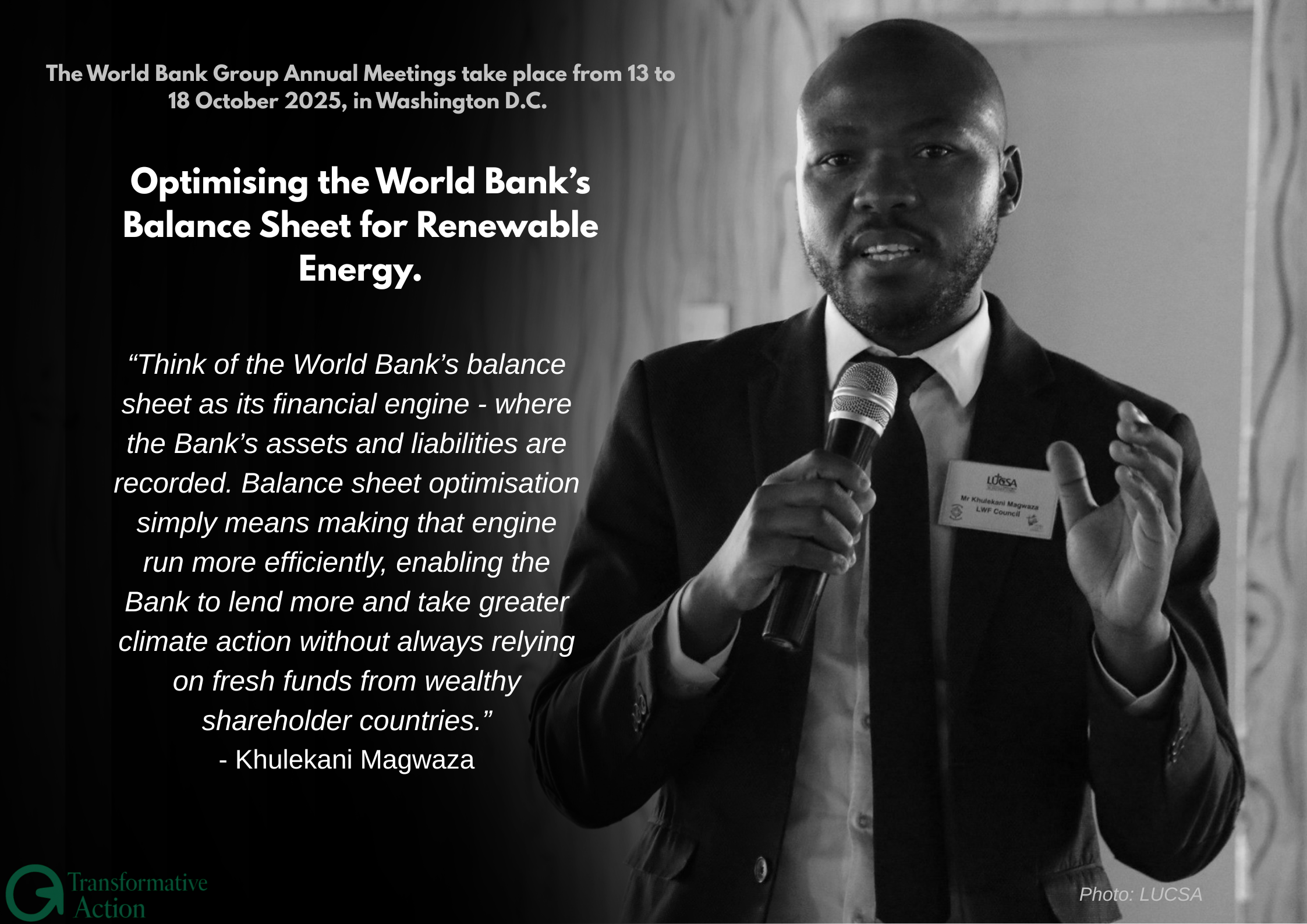
Now think of an MDB’s balance sheet as its financial engine. It holds assets (what the bank owns or invests) and liabilities (what it owes). “Optimisation” means using that engine more efficiently - lending more without needing entirely new funds from rich country shareholders.
How?
Using guarantees and insurance to reduce risk, and
Mixing low-risk and high-impact portfolios to free up capital.
If done right, this could unlock billions in extra lending for solar, wind, off-grid systems, and climate resilience projects in Africa, Asia, and Latin America, exactly where it’s most needed. In simple terms: it’s like getting more mileage from the same tank of fuel.
Capital adequacy refers to how much “buffer” or “cushion” banks keep to stay financially safe. MDBs are proud of their AAA credit ratings, which allow them to borrow cheaply and lend at low interest.
But here’s the debate: are they being too cautious?
Some experts say MDBs hold more reserves than necessary. If they slightly relaxed those rules (without risking stability), they could lend hundreds of billions more for clean energy and climate action. It’s like keeping your entire paycheck in a safe while your house burns, when using a fraction of it could save your home.
Why Does This Matters for Climate & Energy Justice?
If MDBs reformed, optimised, and used their capital better, we could see:
Massive scale-up of renewable energy access, especially in off-grid communities.
Fairer and cheaper finance for developing countries.
Youth and women-led initiatives gaining funding access through localised, just transition projects.
A shift from loan-heavy to equity- and grant-based finance, reducing debt traps.
MDB reform is not just about numbers on a spreadsheet. It’s about who gets to decide the future of development finance, and whether that future will be fossil-fuelled or renewable, extractive or empowering, exclusive or just.
To build a truly just energy transition, the world doesn’t need more climate rhetoric, it needs reformed banks with reimagined balance sheets serving re-energised communities.
Author: Khulekani Magwaza.